by John Goldsby
This interview was conducted during a project with the WDR Big Band, plus Ray Brown, John Clayton, and Christian McBride in 1997.
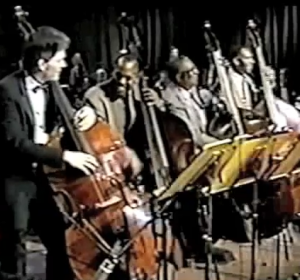
Three generations of the jazz bass tradition made a visit to Cologne, Germany last spring (1997): Ray Brown, John Clayton, and Christian McBride. These master players recorded for one week and played a concert at the Koelner Philharmonie with the Westdeutscher Rundfunk Big Band (the Cologne Radio Big Band). My steady gig is with the WDR Big Band, so I played in the large ensemble sections while Ray, John and Christian played in solo, duo, and trio formations. The arrangements were written by John Clayton, who also conducted the big band . . . in between running back and forth to his bass!
It was a thrill for me to see and listen to and play with these three monsters up-close . . . They confirm everything I believe about the jazz tradition and the progression of techniques and information from generation to generation. In this interview, they assert the importance of role models and mentors on the bass, the value in checking out the history of jazz bass playing, and the usefulness of finding a good mentor. “Superbass” is the name of their three-bass ensemble and their first CD together is called “Superbass, Live at Scullers.”
Ray Brown is one of the legends of jazz; a bass ambassador who has brought his music to audiences world-wide for more than fifty years. He was born October 13, 1926 and started his professional career in the mid-forties. He played with Charlie Parker, Dizzy Gillespie, Bud Powell and others in the seminal days of bebop. He was married to Ella Fitzgerald from 1948 until 1952 and accompanied her on all of the “Jazz at the Philharmonic” (JATP) concert tours. In the 1950’s, he became one of the main protagonists of the JATP line-up. Ray played with the Oscar Peterson Trio from 1951 through 1966; an association that led to many classic recordings.
He has won numerous critics and readers polls beginning in the late forties, and he continues to top the polls today. In the 1970’s. Ray formed the LA 4 with Laurindo Almeida, Bud Shank, and Shelly Manne. Although he has been leading groups sporadically throughout his whole career, he focused on the Ray Brown Trio in the eighties and hasn’t lost steam since. The current trio includes Gregory Hutchinson on drums and Geoff Keezer on piano. At age 71, Ray Brown still maintains a rigorous and productive recording and performance schedule and remains one of the hardest-working players on the jazz scene.
John Clayton is a multi-faceted musician: bassist (classical and jazz), composer and arranger. I first heard John in person at the Derby Dinner Playhouse in Clarksville, Indiana in the mid-1970’s when he was holding down the bass chair with the Count Basie Orchestra. (At that time, I had no idea that twenty years later I would be playing with and for John at a concert in Cologne, Germany . . . small world, huh?!?)
In the late 1970’s, John played in a fantastic trio with pianist Monty Alexander and drummer Jeff Hamilton. While touring with Monty, John was also working hard on his classical chops. He auditioned for, and won, a position as principal bassist of the Amsterdam Philharmonic Orchestra. After a five-year stint in Amsterdam, he returned to the U.S. in the mid-eighties to concentrate on jazz writing projects, the Clayton-Hamilton Jazz Orchestra, and playing the bass. He is one of the most prominent disciples of the “Ray Brown school” of bass playing; a sought-after player who swings, plays beautifully melodic solos, and covers the whole instrument.
Christian McBride was “discovered” in 1986 at the age of fifteen by Wynton Marsalis, who invited Christian to sit-in at a concert in Philadelphia. In 1989, he moved to New York City and quickly became one of the most in-demand jazz bassists. He has played in groups with, among others: Freddie Hubbard, Joe Henderson, Joshua Redman, Roy Hargrove, Betty Carter, and Benny Green. He has recorded almost 100 CDs to date as a sideman and also records and tours with his own group. He sometimes calls Ray Brown “Dad,” a personal and musical indication of his respect for the master bassist who is forty-five years older. He cites Ray, Ron Carter, and Paul Chambers as his biggest influences on the bass. At age twenty-five, Christian is poised to become one of the most influential bassists of the jazz tradition.
Drummer Jeff Hamilton sums up the supportive playing of Ray Brown and John Clayton when he says: “. . . with both John & Ray, there is a similar feeling of strength in their walking that makes me want to play. Also, their desire to play and place 100% of themselves into the music are valuable traits. Their musical, horn-like soloing also stands out as very special; plus sound is very important to both. These are things they knowingly or unknowingly have passed on to me.” I can vouch that Christian McBride also demonstrates the same sense of responsibility in his playing: a commitment to a good bass sound, horn-like solos, and support for his fellow players.
Here is what Ray, John, and Christian had to say about their roles as bassists, bandleaders, and their current and future projects:
Interview with Ray Brown, Christian McBride, John Clayton — by John Goldsby
JG: I want to ask you about the new CD that you guys just made, John can you tell me what it is and what it is called?
JC: I’ll let Ray do that…
RB: Go ahead…he asked you!
JC: It’s called “Superbass,” which is the name of the group and we recorded it in October of last year after Ray had his birthday celebration at the Blue Note in New York. So we played there for a couple of nights as “Superbass” and then we went to Boston the following week and recorded in Boston at Sculler’s Jazz Club.
JG: Was there a rhythm section on that, or just three bass players?
JC: No three basses and then on one song Greg Hutchinson played drums . . . so we’re excited about it.
JG: Ray, you did another “Superbass” CD with John, and Freddie Green . . .
RB: Oh, many years ago . . . and with two Jeffs (Jeff Hamilton – drums, Jeff Clayton – saxophones)….so there were only five guys on that, so we did a lot of over-dubbing.
JG: Yeah, it sounds like a big band.
RB: And he (John Clayton) did the writing for that.
JG: What other projects do you have coming up.
RB: I’m going to try and corral these two guys for next year and we are really going to do some work . . . since we have the record out now. I’ve got some plans to do two or three months with the group. I think we can expand it now that we have some idea; we can start doing some writing for it and stretch out a little bit.
JG: Last year you did a series of concerts: “Jazz meets the Symphony” with Lalo Schiffrin; are you still doing those concerts?
RB: This year we started something new . . . we have my trio with Dee Dee Bridgewater with symphony orchestra and John did the writing and the conducting. We did the Munich Symphony and the Israeli Orchestra in Tel Aviv.
JG: . . . and you’re coming back here in the fall to play with the WDR Big Band and Dee Dee Bridgewater.
RB: Dee Dee has a new CD coming out: “Tribute to Ella” . . . we recorded a couple of days in L.A. , then they recorded a few days in New York, and then he (JC) went to London and put on strings on some of the stuff.
JG: Christian, what are your next projects coming up?
CM: I’m going back out on tour with my band in June and we will be out about three weeks; and then I’m taking the summer off . . . I’m going to stay home and prepare to record my next CD, which I am going to do in September. After that’s over, Joshua Redman and I are co-leading this band; and we are going to go out and do a few dates in the fall.
JG: So, all of you guys are bassist/bandleaders . . . I probably have a large percentage of the bassist/bandleaders in the world sitting right here.
RB: Pretty close!
JG: What are some of your thoughts on being a band-leading bassist?
RB: Well, you can go back in the history of jazz; and there are maybe three guys who have been leaders. And some of those were not active “playing” leaders. A guy like John Kirby had a great band, but he didn’t do anything bass-wise . . . you know what I’m saying. When I say “active,” I meant doing a lot of playing . . . playing melodies and solos and stuff like that.
JG: But he had great arrangements for that band.
RB: Oh, he had a great band . . . the band was fantastic. Originally the Basie band was owned by Walter Page: Walter Page and the Blue Devils. As a matter of fact, he (Christian) was in a movie about that (Robert Altman’s “Kansas City”), that had some of that in there. There again, I think it was the coming of Jimmie Blanton . . . he would have made a great bandleader and I would have liked to have heard a band that he lead. He had the facility to play a lot of things and would have been great to hear him. Pettiford did some band leading, but he didn’t do it on a steady basis. Mingus did some . . . Charlie Haden has done a little bit. There’s not too many people who do it on a regular basis. Christian has a regular band, I have a regular band, and John has two bands: The Hamilton/Clayton Jazz Orchestra, and the Clayton Brothers (co-led with saxophone player Jeff Clayton).
JG: Where did you first hear Jimmie Blanton?
RB: I was selling newspapers . . . there were two guys; one guy lived in this house and next door was a musician. The guy on the left was one of the most famous baseball players of all time: Josh Gibson. I used to deliver newspapers to him; and next door there was a bass player named Carl Pruitt, they called him “Crusher.” He used to always practice with these records and he would have the Blanton solos on, and I would stay there and listen to him take this stuff off the records. And of course I was playing piano at that time . . . I hadn’t gotten to the bass yet, but I was listening to it.
JG: At that time were you aware of Israel Crosby with the Fletcher Henderson or Horace Henderson Bands?
RB: Israel used to play with Benny Goodman when I first heard him, but he didn’t come into prominence as far as I’m concerned until he got with Ahmad Jamal. Then came all of his stuff that he had stored up and had obviously been playing for years; but you could never hear it like that, until he got in the right group.
JG: Christian, where did you first hear Blanton?
CM: I actually came across Jimmie Blanton relatively late, because I was pretty well familiar with Ray’s playing and Ron Carter and Paul Chambers before I got into Jimmie Blanton. My great uncle who is a bass player said: “Well, you know all the modern cats, but you need to take it all the way back!” So I went out and bought the Ellington – Blanton duets: “Body and Soul,” “Pitter, Panther, Patter,” and all that. I was about a senior in high school by that time. When I heard Blanton, I couldn’t believe a cat was playing like that in 1940, 41′ . . . it freaked me out.
JG: Did you do a lot of transcribing when you first started, or did you just listen all the time . . . every time I see you now, you have headphones on and you’re listening to something.
CM: I’ve always done pretty much the same thing. The first bass solo I ever transcribed was a Ron Carter solo. It came from a pretty rare album . . . there used to be a record label called “Galaxy” . . . a label from the 70’s. He did this trio record with Red Garland and Philly Jo Jones. “Solar” is on there, and “But Not For Me” . . . a blues that Ron wrote . . . “Oleo.” I pretty much transcribed everything Ron Carter played off of that record. So then after Ron; came Paul Chambers; then after Paul Chambers came this man right here (Ray Brown). I spent all my time picking note-for-note what they played off the record.
JG: That’s the secret . . .
CM: Yeah . . .
JG: All three of you have great bowing technique; what I would consider “classical” technique, but as you have applied it to jazz and improvised music. John, did you first study classical music, or did you study it after you had already been introduced to jazz bass playing?
JC: It kind of happened at the same time in the beginning; through the public school system . . . playing beginning strings, school orchestras, school band. When I started getting a little more serious, one of my teachers at school found a professional for me to study with, named Ray Siegal. I started taking lessons with him and about that time I heard my first Oscar Peterson record and Ray Brown was playing bass. So, at my next classical lesson, I asked “Mr. Siegal, have you ever heard of Ray Brown?”
Not only had he heard of Ray, but they were good friends. He had a letter from Ray Brown that said “Dear Mr. Siegal, Please tell your students that I will be teaching a class at UCLA called ‘Workshop for Jazz Bass.’ “So that was my last classical lesson with that teacher; I saved $65 and I enrolled in the course. And that’s how I met Ray Brown.
JG: Do you remember that first Oscar Peterson record that you heard?
JC: Oh yeah, “The Trio.” The song that I heard that blew me away was called “Billy Boy.” I had never heard the bass played that fast . . . (laughs) . . . wow, listen to that! After that class, then Ray insisted that I started classical lessons again . . . so I started with Abe Luboff, who is a good friend of his as well.
JG: I remember the first record that I heard Ray on was “We Get Requests.”
JC: Oh, yeah . . .
JG: I had learned “The Days of Wine and Roses” and I thought I kinda “knew it,” but then I heard you (Ray) play it on that record; and that was a big ear-opener for me: the way you played it and played the counter-lines, and outlined the harmony.
JC: I have my students transcribe that record.
RB: We have a series of videos out now . . . one with John and me, one with Milt Hinton doing all that slap stuff: I got it in slow-motion so you can get a good look at it . . . one with Francios Rabbath.
JG: He’s got his own technique!
RB: Oh, yeah! There’s another one with a trio we had called “Triple Treat” with Monty Alexander and Herb Ellis. I’m going to corner Christian for one of these too . . .
JG: Christian do you have any plans to “crossover,” for lack of a better word, and make a “popular music video” for the MTV market?
CM: I’d like to, but I’d like to do it where I don’t have to do anything silly. My number one priority is to somehow have jazz be appreciated more by people in my age bracket. From what I’ve noticed, they seem to really enjoy it, but they are just not exposed to it. When they hear a jazz group they’re like: “Wow, I never knew that’s how that was supposed to be!” You know, the image of jazz is that of cats gettin’ high and you gotta be in a club where you can hardly breathe in ’cause the smoke is so thick . . . cats vomitin’ and throwin’ up all over the place ’cause they’re drunk and too tough. But that’s what the image is of jazz. So, I’m trying my best to do away with that. Every time I go on the road; say I’m in a city for a week or so . . . I always like to call around to different inner-city schools and take my band in there and play for the kids during the day. I find that 90% of the time, a lot of those parents will bring those kids to the show at some point during the week. Man, if this is this easy . . . I’m going to do this all of the time.
JG: The industry just has to reach out a little bit.
CM: Oh yeah, they make it sound like it’s hard, but it’s not hard. They’re the ones responsible for making it so that they (young people) are not exposed to it. They could take all of the same things they’ve done to take it away from them to give it back to them.
RB: I think he (Christian) is a good guy to have make a video because all the stuff he does is a mixture, and it’s good for the kids to see that.
JG: What projects would you like to do or who would you like to work with that you haven’t had the chance to yet . . . if there is anybody?
RB: You’re not talking to me, are you? (big laughs)
JG: I can’t ask you, because you’ve worked with everybody . . . I know everybody wants to work with you . . .
CM: Yeah, right . . .
JG: John, do you have any projects that you would like to see produced?
JC: Well, there are still some people on my list that I haven’t played with . . . I’m a huge fan of Oscar Peterson’s . . . I’m also a big Ahmad Jamal fan. I’d like to explore more what Ray and I have touched on: jazz bass players in combination with symphony orchestras. I’d really like to see more of that so bass players are spotlighted with large ensembles. And what we are doing here with the WDR . . . I’d love to see more bass players spotlighted as soloists. As much as I love ’em, we’ve had enough trumpet players and saxophone players in front of the band . . . how ’bout us?
CM: Amen!
JG: And the bass players go over just as well . . .
JC: Absolutely! There’s a long list, but those are some of the things that I’d like to do. I also want to do more with my brother Jeff, and the Clayton Brothers band. He lives in New York now and we play together as often as we can, but we really have to plan it now. I really like playing with him.
JG: Do you guys have any advice for young bass players just starting out?
CM: Listen to Ray Brown!
JG: Ray Brown, what would you say?
RB: Listen to these two guys! They’ve brought it forward! That’s the good thing about this Superbass group: I’m thirty years older than John and he’s almost twenty years older than Christian. That is a great spread and there’s a lot of history here . . . and its approached from different angles and that’s what I think makes it work.
JC: One thing I would like to add . . . I suggest that all young bass players do what Ray Brown had me do and what the older bass players who advised Christian had him do; and that is: get with a teacher . . . really important. You can teach yourself so much and then after that, you need to have criticism from somebody who has been there and knows the efficient ways to do things and who has had experience. You really get helped a lot further and a lot faster if you study with somebody like that. Learn the bass . . . Ray was great in insisting that I learn the bass from the nut to the bridge . . . Get with a teacher and learn the bass from top to bottom.
***
© 1997 John Goldsby
All Rights Reserved — reprints by request